
axiSOL or Direct Staking: Fees and Withdrawals Compared
Axiom offers two ways to stake SOL: hold axiSOL from the Yield tab, or delegate straight to the Axiom validator from a wallet such as Phantom or Ledger. Both earn from the same validator. They differ in fees, in how you get out, and in where the staked SOL lives while it works.
 Updated November 21, 2026
Side by side
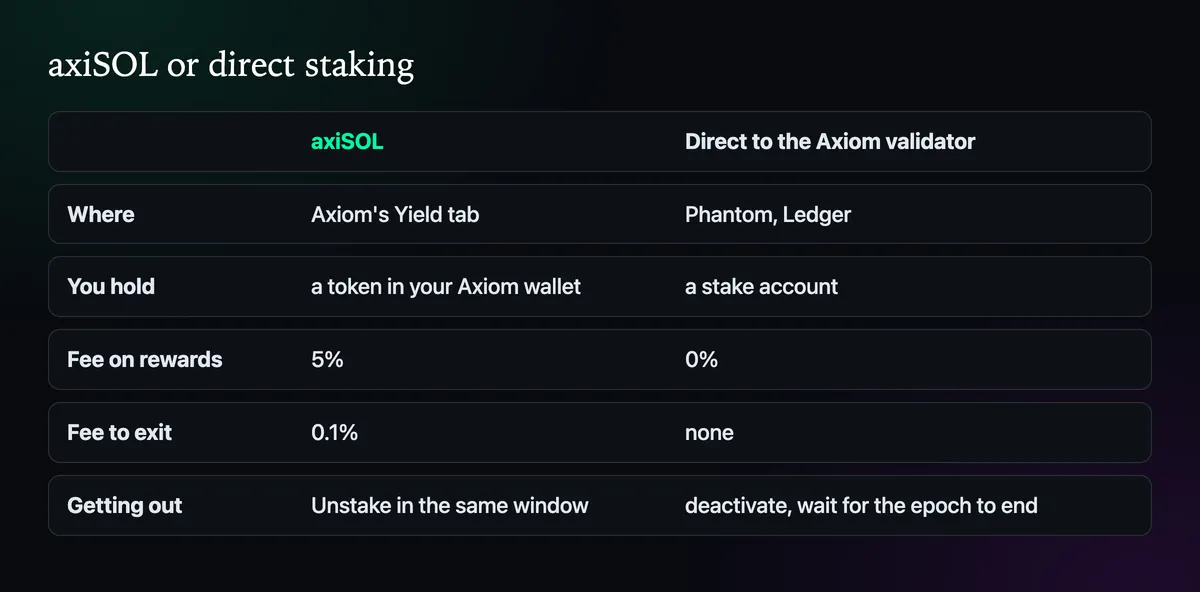
With axiSOL you stake inside Axiom and hold a token. With direct staking you delegate from your own wallet and hold a stake account. The validator, and so the gross rewards, are the same; what changes is who takes a cut and how you leave.
What each one costs
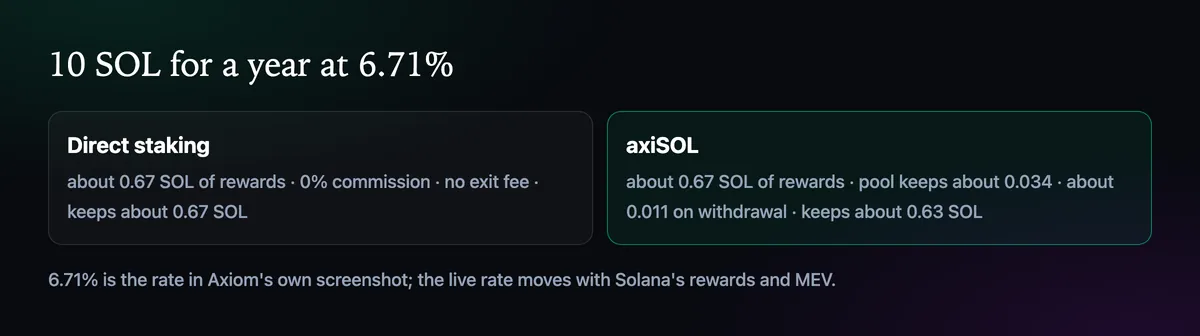
Direct staking costs nothing beyond the network fee: the validator's commission is 0% and there is no exit charge. axiSOL's pool keeps 5% of rewards and charges 0.1% when you withdraw. On 10 SOL earning 6.71% for a year, that is roughly 0.67 SOL of rewards, of which the pool keeps about 0.034, and then about 0.011 on the way out. Small numbers, but they scale with the stake.
What axiSOL gives you for the fee
Convenience, mostly. axiSOL lives in the same Axiom wallet you trade from, you stake and unstake in one window, and you never need a second app. It is also a token rather than a locked stake account, so it can be moved like one. Direct staking keeps the SOL in a wallet you control separately, Phantom or a Ledger, which some people prefer for savings they do not want sitting next to their trading balance.
Which one to pick
If the SOL is long-term savings and you already use Phantom or a Ledger, stake directly and keep the full reward. If it is SOL you trade with and only want earning between trades, axiSOL inside Axiom is simpler. Both routes are set out step by step in How to Stake SOL on Axiom for axiSOL and How to Stake to the Axiom Validator from Phantom or Ledger.

Written by Mohammad Shahpari · Web3 CMO, Crypto Growth & SEO Specialist · X · LinkedIn
Did this answer your question?