

Best Axiom Trade Filters for Memecoins
The best Axiom Trade filters for memecoins are a handful of caps and minimums, set separately for each Pulse column: caps on what the developer, the top ten wallets, snipers, insiders and bundles hold, and minimums for holders and volume. This page gives three ready sets with exact numbers, shows which filters do most of the work, and explains how to tune a set after a few days of watching it. Every trade from a filtered feed costs 0.8% with code TradeNow.
 Set Filters on Axiom (20% Off)
Axiom Trade Invite Code: TradeNow
The Axiom Trade invite code is TradeNow. Axiom calls it a referral code. Enter it when you sign up and your trading fee drops by 20% for the life of the account, from 1% to 0.8% a trade.
If you are looking for an Axiom Trade invite code, use TradeNow. Type it into the referral field on the sign-up screen, or open axiom.trade/@tradenow and it is filled in for you. It is one of the most used Axiom codes, and it still works.
What are the best Axiom filters for memecoins?
Cap dev holding at 5%, top 10 holders at 30 to 35%, snipers at 15 to 20% and bundles at 10 to 15%. Then ask for at least 10 holders on New Pairs, 75 on Final Stretch and 250 on Migrated. Those few limits hide most launches where a small group already owns the supply.
Axiom keeps a separate filter set for each Pulse column, so the right numbers depend on how old a coin is. The three sets below follow that.
| Where | Pulse, the filter icon in each column's toolbar |
|---|---|
| Filter sets | Three: New Pairs, Final Stretch and Migrated each keep their own |
| Numeric filters | Fourteen, each with a minimum and a maximum |
| Other rules | Launchpads, quote tokens, keywords, bonding curve %, Dex Paid, socials |
| Blacklists | Developers, funding wallets, contracts, keywords, websites, X profiles, KOL handles |
| Sharing | Export a set as text and import it on another account |
| Cost | Free; Axiom charges only when you trade |

Three Ready Filter Sets
Each set is named for the job it does. Type the numbers into the matching tab of the Filters window. A box you leave empty sets no limit.
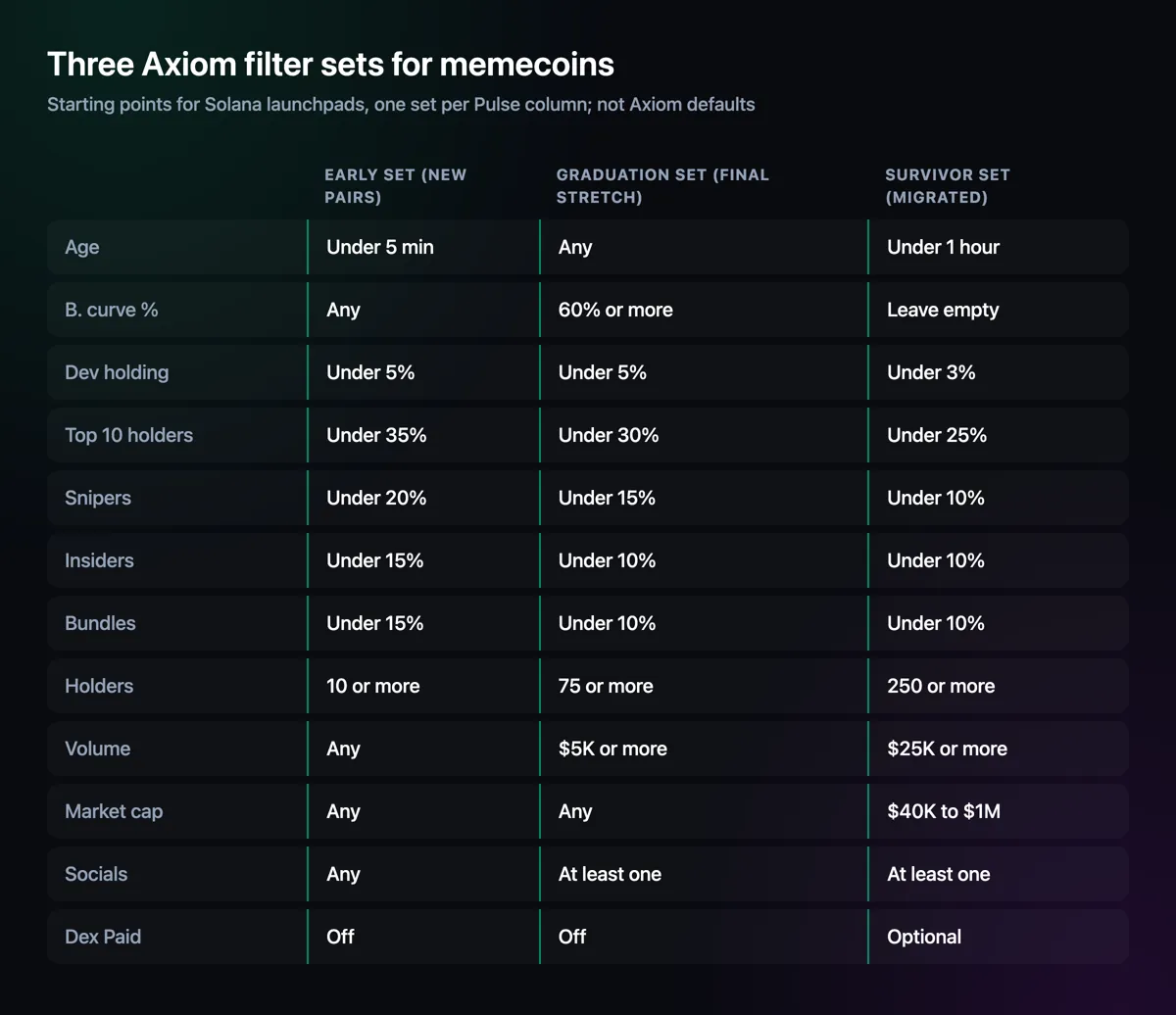
Why Each Set Looks the Way It Does
Early set, for New Pairs
New Pairs lists coins that are seconds or minutes old. Holder counts are tiny and volume says nothing yet, so this set is loose on activity and strict on ownership. The 5 minute age limit keeps the list fresh. The dev cap removes launches where the creator bought a large first bag, and the bundle cap removes the ones where a group of wallets bought in the same block. Ten holders is a low bar on purpose: set it higher and the coin reaches you after the first move is over.
Graduation set, for Final Stretch
Final Stretch holds coins filling the last part of their bonding curve. A coin that got this far should have a crowd, so the holder minimum rises to 75 and volume has to pass $5,000. Bonding curve percent is the filter that belongs to this column. A minimum of 60 hides coins that have drifted for hours and are unlikely to finish. The caps on top 10 and snipers get tighter here because those wallets will be selling into the migration.
Survivor set, for Migrated
Migrated shows coins that just moved to an open pool, where anyone can sell any size. This set asks for the most: 250 holders, $25,000 of volume, and a market cap between $40,000 and $1 million, which leaves out both dead coins and ones that have already run. Asking for one social link costs little at this stage, since most real projects have one by now. Dex Paid is optional. It keeps only coins whose team paid for a DEX Screener profile, which shows effort and says nothing about honesty.
These are our starting numbers for Solana launchpads. Axiom does not ship them as defaults, and nobody's numbers hold in every market.
Which Axiom Filters Matter Most for Memecoins
Fourteen boxes is a lot to fill in, and most traders leave half of them empty. If you set only five, set these, in this order.
- Dev holding %. The creator's share is the one bag a single person can dump. Under 5% is a common line. A dev at 0% is not automatically safe, because the bag may have moved to another wallet.
- Top 10 holders %. Ten wallets holding more than a third of a coin can end it in a few sells. This cap also catches supply a dev has spread over several wallets.
- Bundle %. Buys packed into the launch block usually come from one buyer using many wallets. A high bundle share next to a low dev share can mean the dev bought through other addresses.
- Snipers %. Bots that bought in the first seconds sell into the first green candles. Some sniping happens on every launch; a fifth of the supply is too much.
- Holders. The only minimum in the five. It removes coins nobody has touched, at the price of showing you everything else a few seconds later.
Insiders, pro traders, liquidity, transactions, buys and sells are for fine tuning once the five above are in place. The memecoin sniper page explains what each of the fourteen measures.
The Switches Above the Numbers
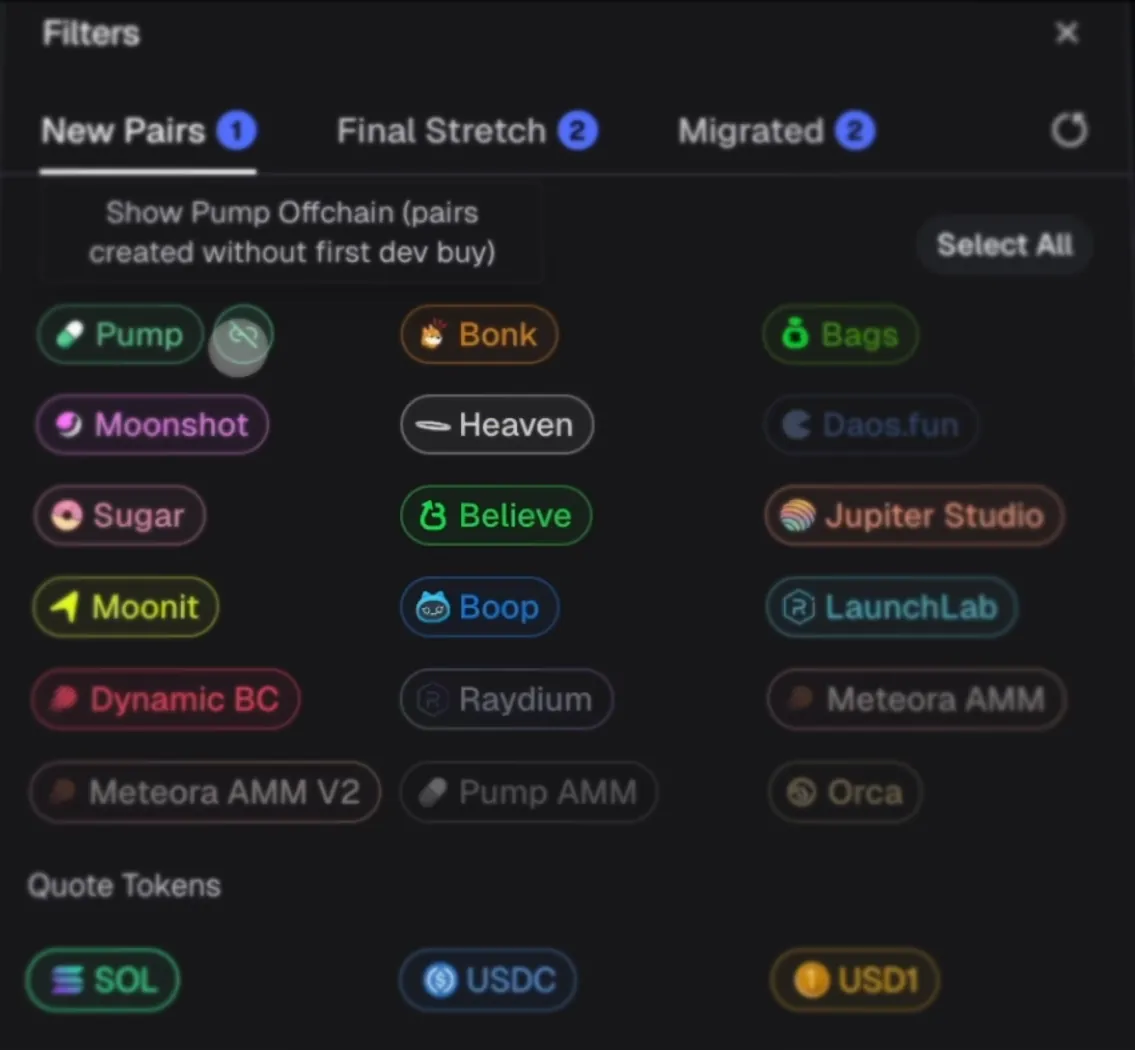
The top half of the Filters window has no numbers in it, and it removes more noise than any percentage. Protocols are the launchpads and pools a column reads: Pump, Bonk, Bags, Moonshot, Believe, LaunchLab and more, each a chip you switch on or off, with Select All beside them. Quote Tokens limits the column to pairs priced in SOL, USDC or USD1. A small switch next to Pump shows or hides Pump.fun coins created offchain, meaning without a first buy from the developer.
Keywords, Bonding Curve and the Audit Boxes
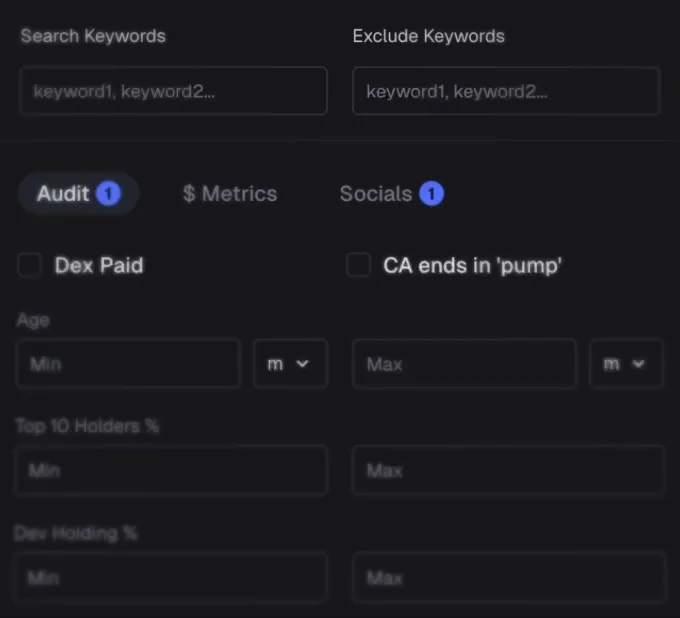
Search Keywords keeps only coins whose name or ticker contains your words, and Exclude Keywords drops them. Excluding the day's most copied meme is the quickest way to make New Pairs readable. Below the keywords, B. curve % takes a minimum and a maximum for bonding curve progress. The Audit tab then adds two tick boxes: Dex Paid, and CA ends in 'pump' for contracts that carry the Pump.fun address ending.
The Socials tab can require an X account, or at least one social link of any kind. Recent versions of the window also accept developer wallets and X handles, added one per row.
Blacklists: Filters You Build Yourself
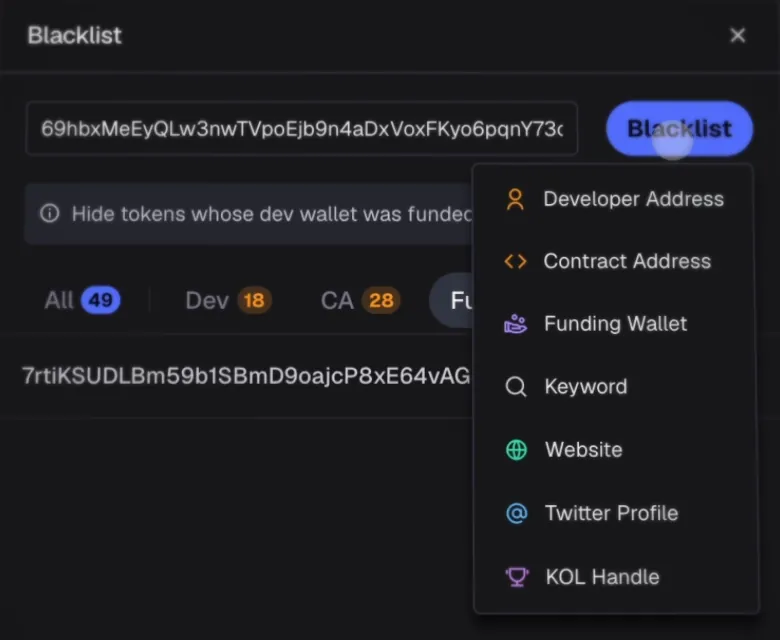
A filter hides coins by their numbers. A blacklist hides them by who made them, and it applies to every column at once. The Blacklist window opens from the icon beside Display at the top of Pulse and accepts seven kinds of entry: a developer address, a contract address, a funding wallet, a keyword, a website, an X profile and a KOL handle.
The funding wallet entry is the strongest of the seven. Serial launchers change developer wallets for every coin but tend to pay for them from the same place, so blocking the funder hides the whole run of launches. On any Pulse row you can also hover the token picture and blacklist its developer in one click. The list has its own Import and Export buttons, separate from the filter sets. The guide's Pulse filters walkthrough shows the clicks.
How to Tune a Filter Set
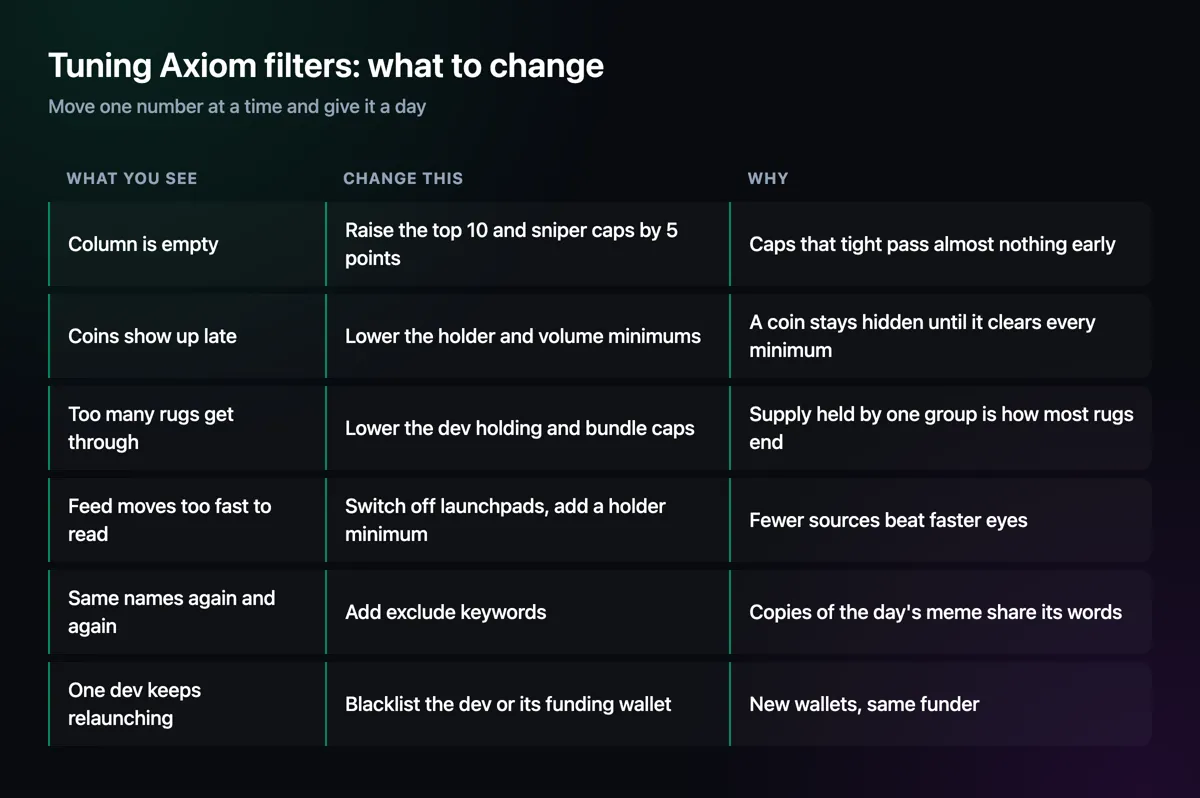
No set survives a change in the market. When launches slow down, tight filters leave a column empty; in a frenzy the same numbers let hundreds of coins through. Change one number, leave it for a day, and write down what you changed.
Export Before You Experiment
Press Export in the Filters window before changing anything. It copies the current column's set as text, and Import pastes it back, so a working setup is never more than one paste away. The same text is how traders pass sets to each other. Read a stranger's set before importing it. It replaces yours for that column, and a set with an odd keyword or a single launchpad switched on may be built to show you one particular coin.
If a column stays empty after you loosen it, the cause is usually a chain or launchpad switch. The Pulse page lists the checks.
Filters on BNB, Base and the Other Chains
The Filters window is the same on all nine chains Axiom supports. Only the protocol chips change, to that chain's launchpads: Four.meme on BNB Chain, Clanker and Zora on Base, Pons on Robinhood Chain. The numbers should change too. Quieter chains have fewer wallets per launch, so holder and volume minimums copied from Solana hide almost everything; halve them and work up. Ownership caps travel better, because a dev holding 20% is a problem on any chain.
On BNB Chain and Robinhood Chain, the Copy Mark option under Appearance flags rows that reuse an earlier token's name or ticker, which does part of an exclude keyword's job.
What No Filter Can Tell You
Every figure in the window describes the coin as it is this second. A dev who sold through a second wallet before launch shows 0%. Volume traded between a few hundred wallets owned by one person looks like demand. Filters shorten the list and do not vouch for what is left on it. Keep sizes small on anything minutes old, and decide the exit before the buy.
Set Up Your Filters in Four Steps
Enter invite code TradeNow
Create the account at axiom.trade/@tradenow. The code is already in the link and takes the fee on every trade from 1% to 0.8%.
Open a column's filters
In Pulse, click the filter icon in the New Pairs toolbar. The window opens on that column's tab.
Type in a set
Enter the numbers from the table, switch off launchpads you do not trade, and press Apply All. Repeat on the other two tabs.
Export and review
Export each set, watch the feed for a few days, then change one number at a time.
Axiom Trade Filters — FAQ
What are the best Axiom Trade filters for memecoins?
Caps on dev holding (5%), top 10 holders (30 to 35%), snipers (15 to 20%) and bundles (10 to 15%), plus a holder minimum that grows with the column: 10 on New Pairs, 75 on Final Stretch and 250 on Migrated.
Where are the filters on Axiom?
In Pulse. Each of the three columns has a filter icon in its toolbar, and the window that opens has a tab per column.
Can I import someone else's Axiom filters?
Yes. Export copies a column's set as text and Import pastes one in. An imported set replaces your current one for that column, so export yours first.
Why does Pulse show nothing after I set filters?
The limits are too tight for the current market, or a launchpad or chain is switched off. Clear the holder and volume minimums first, then check the protocol chips.
Do the same filters work on BNB Chain and Base?
The window is the same, with that chain's launchpads as protocols. Lower the holder and volume minimums, because launches there draw fewer wallets.
Do Axiom filters cost anything?
No. Filters and blacklists are free. The trading fee is 1%, or 0.8% with referral code TradeNow.
Can filters stop rug pulls?
They remove the obvious ones. A prepared rug can pass every filter, so position size still matters more than any setting.
Axiom Trade Guide
Step-by-step help for every part of the terminal, from opening an account to withdrawing, with screenshots from Axiom itself.
Disclaimer
The filter sets on this page are starting points, not Axiom defaults, and no filter makes a new token safe. Not financial advice.

Written by Mohammad Shahpari · Web3 CMO, Crypto Growth & SEO Specialist · X · LinkedIn